
Guide
What a Technician Checks First on a Columbia Garage Door
A look at what our techs check first on Columbia garage doors, tied to the area's 1960s-70s housing stock and severe cold winters that stress springs and hardware.
Local detail
The Common Mistake
The mistake we see most in Columbia is treating a noisy or sticking door as a lubrication problem. Someone sprays the track, the noise quiets down for a week, and then the door starts binding again. In villages like Oakland Mills, Wilde Lake, and Harper's Choice, where most houses date back to the 1960s and 70s build-out of the town, the door hardware is often original or close to it.
A torsion spring that's been cycling through decades of cold Maryland winters doesn't get quieter with oil - it gets closer to failing. Lubricant treats the symptom on the roller and hinge, but it does nothing for a spring that's lost tension or a cable that's starting to fray at the drum. We understand why people reach for the can of WD-40 first; it's cheap and it seems to work.
But on a house built when Columbia's early neighborhoods were going up, the spring under that door has likely seen forty-plus winters of expansion and contraction, and that wear doesn't reverse. Catching it early, before the spring lets go under load, is the difference between a scheduled repair and a door that drops on someone's hand or car roof.
The area
What Is Going On
Columbia sits in a severe cold climate band, and that matters more for a garage door than most people expect. Steel torsion springs lose a small amount of tension every time they cycle through a hard freeze-thaw swing, and galvanized lift cables stretch slightly with repeated cold contraction. Add in a housing stock that runs from 1948 up through recent builds but centers around a median year of 1976, and you get a lot of doors in Town Center, Owen Brown, and Long Reach running original torsion hardware that was never rated for forty-plus years of service.
Wood panel doors from that era swell and shrink with the season, which throws off the balance point the springs were set for. Steel panel doors from the same period often have foam-backed insulation that's degraded, so the door itself weighs more than it did when the spring was sized for it. None of this shows up as an obvious break.
It shows up as a door that's slightly harder to lift by hand, an opener that strains for an extra second before the door moves, or a faint grinding at the top of the track. That's the sequence we're trained to catch before it becomes a snapped cable or a spring failure.
What we find
What to Check
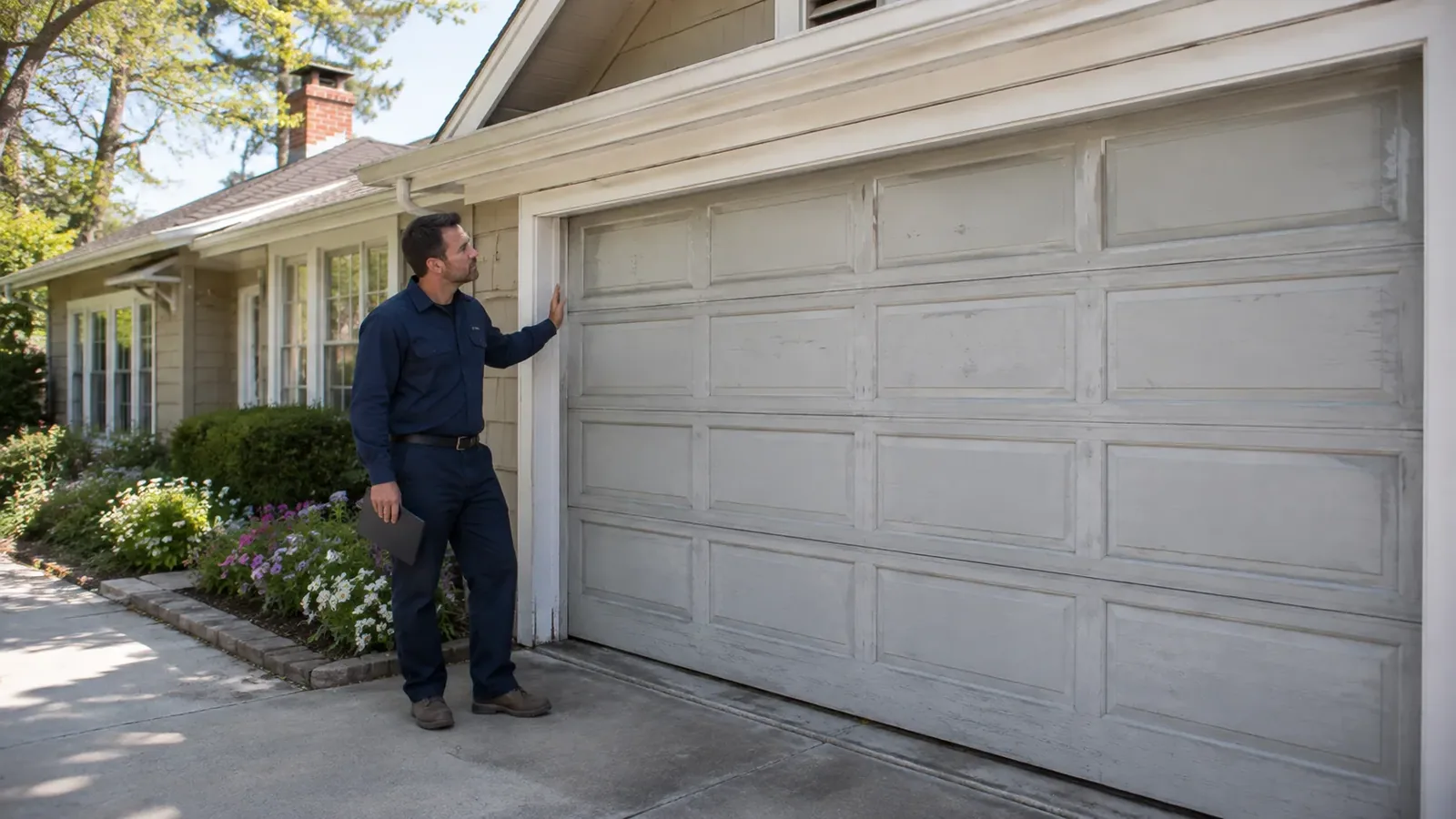
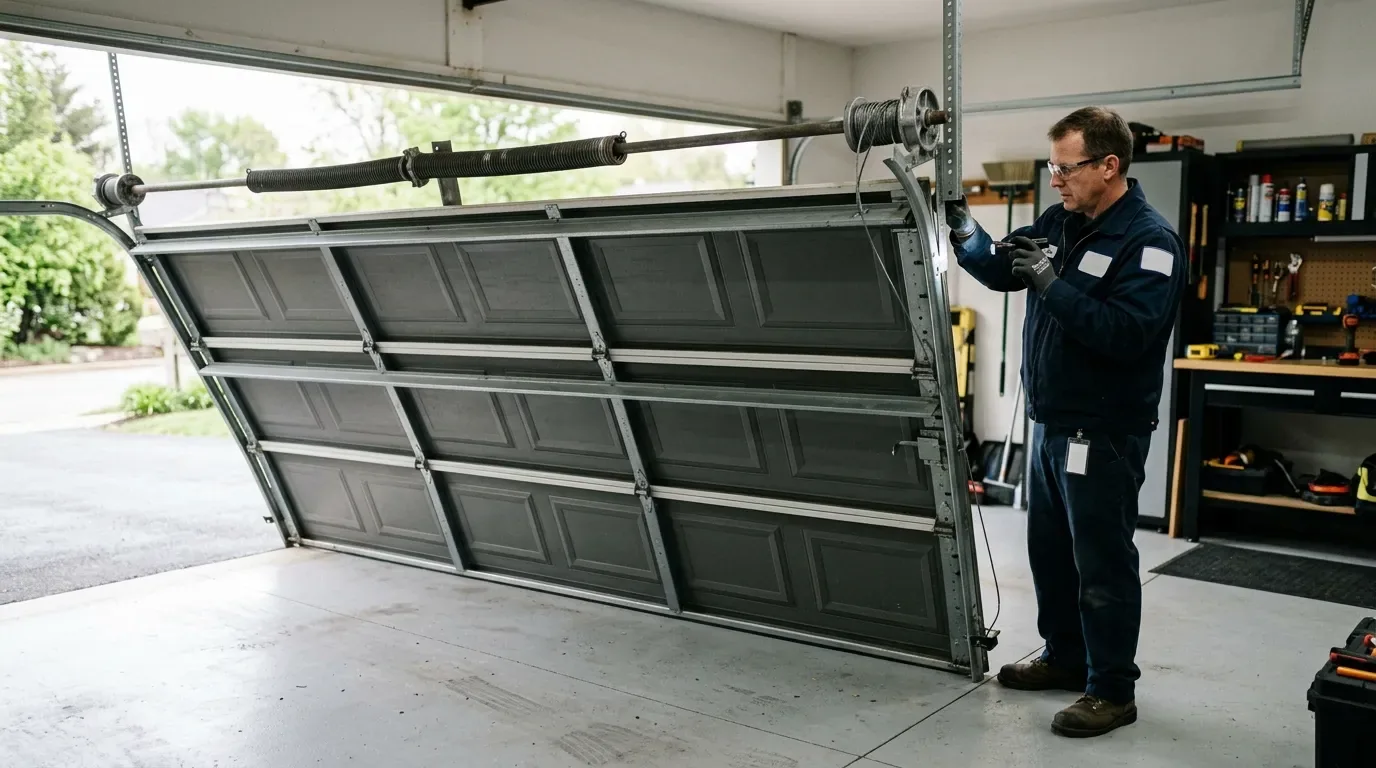
On a first visit we start with the springs - checking for gaps in the coils, rust at the stress points, and whether the door balances at roughly waist height when disconnected from the opener. Next is the cable and drum: fraying near the drum end is the most common failure point on doors that have run fifteen years or more without a spring adjustment. We check track alignment at the curve, since houses in the older villages often have concrete pads that have settled slightly over decades, which throws the vertical track out of plumb. We look at roller wear, especially on the original steel rollers many of these doors still carry instead of nylon.
Weatherstripping at the bottom panel gets checked for compression and cracking, since a stiff cold-climate winter is hard on rubber. Last, we test the opener's force settings against the door's actual weight rather than trusting the factory default, because an opener fighting an out-of-balance door will burn out its motor early. One thing we don't do on a first visit: pull a spring apart to inspect the wire gauge unless the homeowner asks, since that's a job better done with the door already disconnected and secured.
How we work
What Local Conditions Do
Cold winters do specific, measurable things to a garage door that milder climates don't. Metal contracts, which tightens tolerances at the track and can cause a roller to bind right when you need the door most - on a freezing morning before work. Springs that were wound to lift a certain weight at 70 degrees don't lift quite the same at 20 degrees, so a door that closes fine in July can feel heavy or drop unevenly in January.
Vinyl and rubber weatherstripping stiffens and cracks faster here than in a mild-winter region, letting cold air into the garage and, on attached garages common across Columbia's villages, into the house itself. None of this is unique to one street - it's a function of the severe cold band this whole area sits in, combined with a housing stock old enough that a lot of the original hardware is still in service. The honest limitation: if your spring size is an older or oversized gauge no longer common, we may not have it on the truck and will need a day to source it rather than force a mismatch that won't hold.
Questions
Common questions
How old does my garage door have to be before the spring is a concern?
There's no single cutoff, but most of the doors we service in Columbia's older villages went in when the homes were built, and that stock centers around 1976. A spring that old has absorbed decades of cold-season cycling. If yours hasn't been adjusted or replaced since the house was built, it's worth a check before it fails on its own.
Why does my door feel heavier in the winter?
Cold contracts the metal in the torsion spring slightly, which changes how much lift it provides compared to a warm day. In a severe cold climate like this one, that difference is noticeable enough that a door balanced in summer can feel harder to lift by hand come January.
Can you fix the door same day if the spring is an odd size?
Usually, but not always. Some of the older, larger-diameter springs from 1960s and 70s installs aren't ones we keep stocked on every truck. If yours is one of those, we'll tell you upfront and get it sourced rather than install something that won't balance the door correctly.
Do I need to replace both springs if only one breaks?
Not always, but on a door old enough to be original to a 1960s or 70s build, the second spring is usually close to the same age and close to the same wear. We'll check its condition on site and give you a straight answer rather than push a two-spring job you don't need.
Ready when you are
Need a garage door sorted in Columbia?
Columbia Garage Door Pros repairs and installs garage doors, springs and openers in Columbia, MD and the surrounding area.