
Guide
What That Noise From Your Garage Door Is Telling You
Columbia homes built between 1948 and 2014 carry different garage door hardware, and cold winters change how each one sounds. Here's what those noises mean.
Local detail
The Common Mistake
Most people hear a new sound from the garage door and either ignore it or hit it with whatever's on the shelf - WD-40, usually, sprayed on anything metal and moving. That's the common mistake here, and it's a bigger problem in Columbia than it would be in a newer subdivision somewhere else. The housing stock in this service area spans 1948 to 2014, with a median build year of 1976, which means a squeak on a door installed in the last decade and a squeak on original 1960s-70s hardware in Wilde Lake or Oakland Mills are two completely different problems wearing the same sound. Spraying lubricant on a worn roller bearing doesn't fix the bearing - it just masks the noise for a week and lets the wear keep going.
The other version of this mistake is assuming the noise is cosmetic. A grinding sound on an older torsion setup is often metal fatigue, not dirt. We're not going to tell you every noise means a $600 repair, because that's not honest either - but treating all noise the same, regardless of the door's age, is how a $40 roller job turns into a spring failure six months later.
The area
What Is Going On
Across the villages that make up this area - Town Center, Oakland Mills, Owen Brown, Hickory Ridge, Harper's Choice, Long Reach, Kings Contrivance, River Hill - the bulk of the housing went up in the 1960s and 70s, which puts a lot of original or first-replacement garage door hardware well past its expected service life. A steel roller from that era, running in a galvanized track that's since picked up decades of surface rust, makes a scraping or clicking sound that's mechanical wear, not debris. A hollow-core door from the same period, hung on hinges that have never been re-torqued, produces a rattle at each panel joint as the hinge pin wallows out its hole.
Newer builds in the same 87-area footprint - the ones built closer to 2014 - tend to have nylon rollers and sealed bearings, so a noise there usually points somewhere else: an opener gear, a loose bracket, or a cable that's started to fray. The point is the noise doesn't tell you the cause by itself. It tells you where to look, and where to look depends heavily on when the door and track were put in, which in a service area with this wide a build-year spread varies house to house even on the same street.
What we find
What to Check
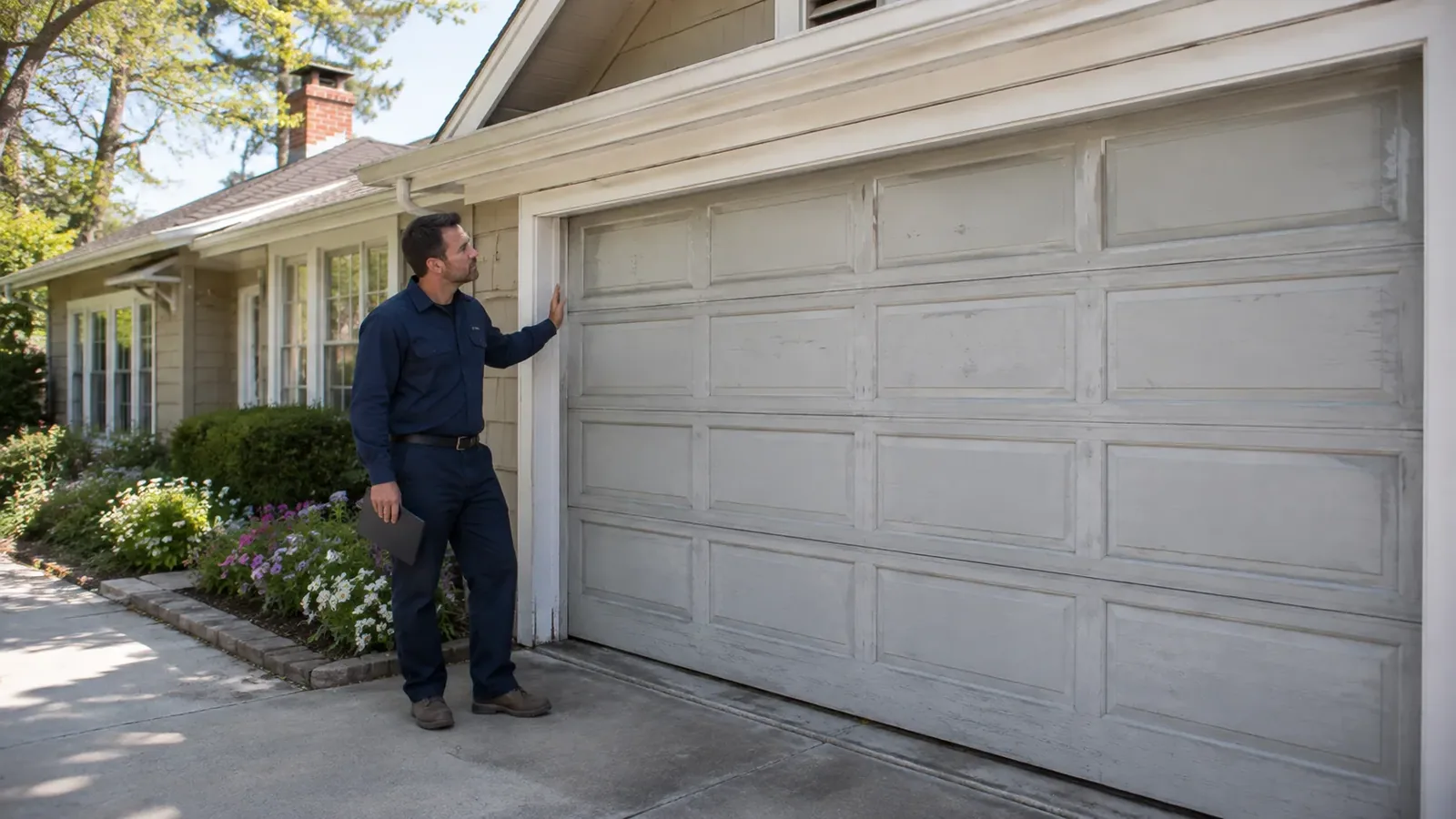
Start at the track. Run a hand along it (door closed, power to the opener disconnected) and feel for a step or gap where the rail has pulled from the wall - common on original 1960s-70s mounting brackets that were never upgraded to lag bolts. Next, check each roller: grab it and try to wiggle it side to side.
Movement of more than a slight give means the bearing is shot. Look at the hinges between panels for elongated screw holes, which show up on doors that have flexed for years on the same hardware. Listen for where the noise happens in the door's travel - right at opening, it's usually the spring or the drum; partway through, it's the track or a specific roller; at full close, it's often the bottom bracket.
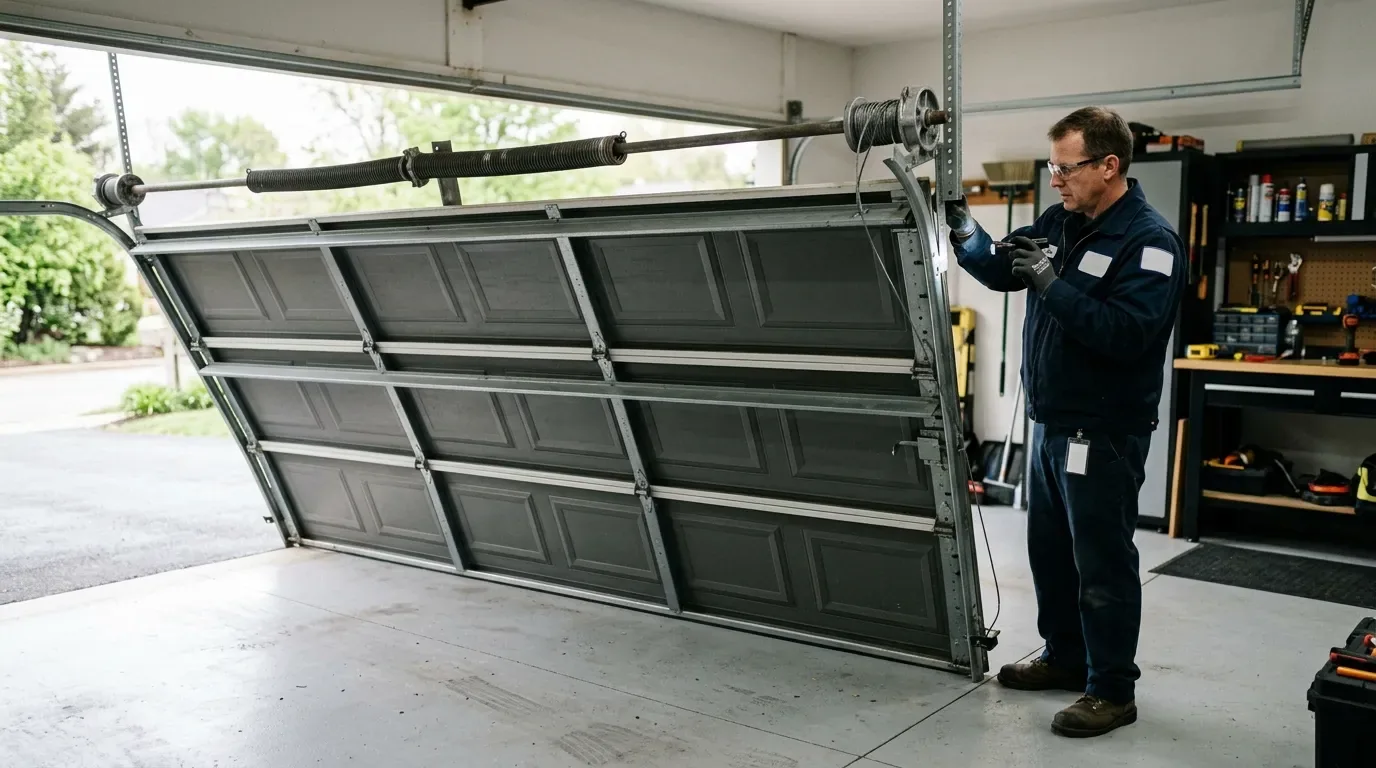
If you've got a torsion spring system, do not touch the spring itself - that's not a homeowner check, that's how people get hurt. One honest limit here: we can talk you through what to look at, but we can't diagnose a specific squeal or grind accurately over the phone. Some noises need a hand on the door to place.
How we work
What Local Conditions Do
This area sits in a climate band we'd call cold-severe, and that changes what a garage door sounds like in January versus July. Steel track contracts in hard cold, which can turn a barely-there roller gap into an audible knock every time the door runs. Grease that was fine in summer stiffens up, so a hinge that swung quietly for months starts to grind - not because anything broke, but because the lubricant can't do its job below a certain temperature.
This hits older hardware harder: a hinge or roller from the 1960s-70s stock common across this service area has looser tolerances to begin with, and cold just exposes the slack. Spring steel also fatigues faster with repeated cold-to-warm cycling, which is part of why a spring installed decades ago on an original setup is more likely to announce itself with a bang in winter than in August. None of this means every winter noise is an emergency.
Plenty of it is just a door telling you it wants fresh lubricant rated for low temperatures, not the household can under the sink. But a new grinding sound that shows up with the first hard freeze, on a door old enough to remember the last one, is worth a look before it's not optional anymore.
Questions
Common questions
My garage door started grinding as soon as it got cold. Is that normal?
It's common, especially on older hardware. Cold stiffens grease and contracts steel track, which turns small gaps and worn rollers into noise they didn't make in warmer months. It's not always urgent, but if the grinding is new and sharp rather than a gradual squeak, it's worth having someone look before the next cold snap.
Does the age of my house tell you anything about the door noise?
Somewhat. Houses in this area were built anywhere from 1948 to 2014, with most from the 1960s and 70s. Older original hardware tends to have steel rollers and looser tolerances, which grind and rattle differently than the nylon rollers and sealed bearings common on newer installs. It's a clue, not a diagnosis.
Can I just spray lubricant on the noise and see if it goes away?
You can, and sometimes it buys time. But lubricant doesn't fix a worn bearing or an elongated hinge hole - it just quiets the symptom for a while. If the noise comes back within a few weeks, the part needs replacing, not more spray.
Is a banging sound from the spring always a break?
Not always, but a loud bang from the top of the door is worth taking seriously, especially on an older torsion setup that's been through many cold-to-warm cycles. Don't try to inspect or touch the spring yourself - that part of the system is under real tension.
Ready when you are
Need a garage door sorted in Columbia?
Columbia Garage Door Pros repairs and installs garage doors, springs and openers in Columbia, MD and the surrounding area.